She Was a Major Figure of Us Art Many Paintings of Circles of Flowrs
There are few artists in history whose work is consistently reduced to the single question: flowers or vaginas?
But a new Tate Modern retrospective of Georgia O'Keeffe, a giant of American 20th-century modernism, is to challenge the "conservative male person" – and widely accepted – assumptions that her famous flowers paintings are depictions of female genitalia.
The show, which opens in July, will be the Uk's largest ever exhibition of O'Keeffe's work and volition exist Tate Modern'due south offset testify since its £26m revamp. Featuring more 100 works, which accept rarely left America since her death in 1986, it will display her 1932 Jimson Weed painting, which in 2014 became the most expensive painting sold at auction past a female artist when it was bought for $44.4m.
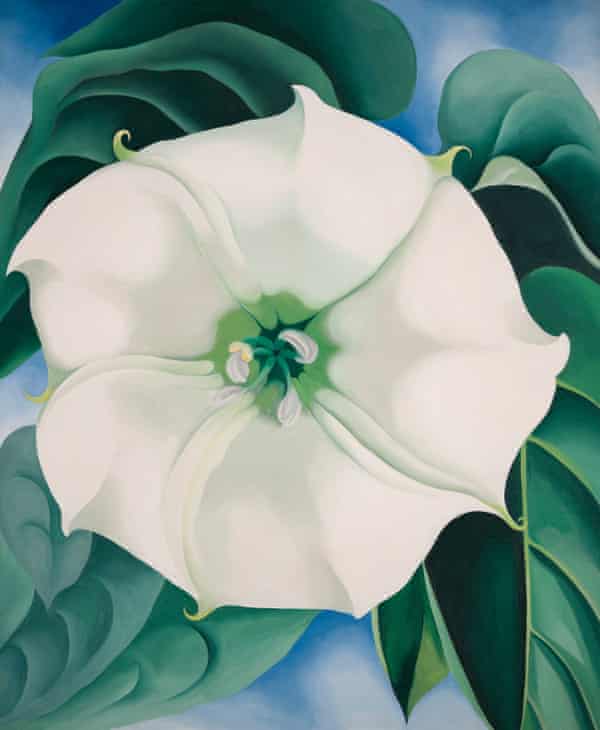
It has been exactly a century since O'Keeffe starting time showed her work at 291 gallery in New York, and she is still considered one of the nigh celebrated painters of the 20th century.
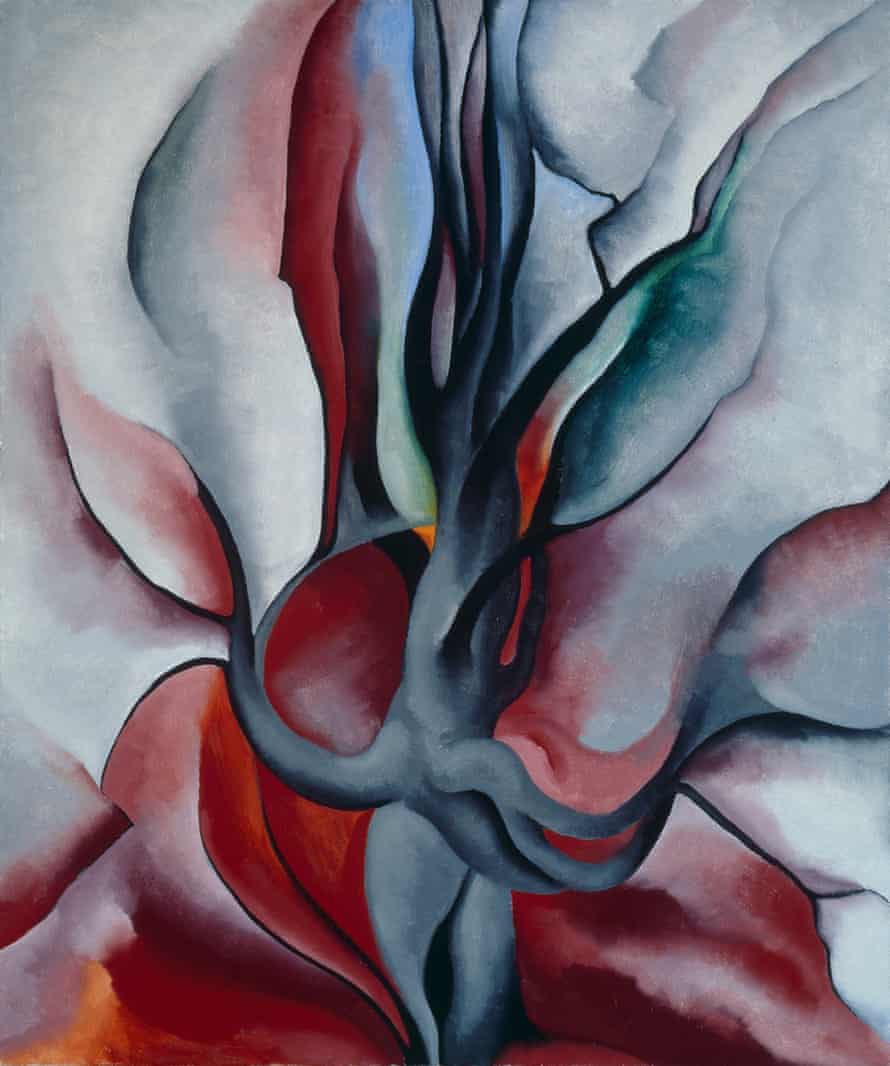
She is best known for her large-scale studies of flowers, painted as if looking at them through a magnifying glass. However, since the early 1920s the vast oil works take been dogged by erotic interpretations and, despite O'Keeffe's six decades of vigorous denial that her paintings were in any way sexual, it remains a ordinarily held assumption to this solar day.
Achim Borchardt-Hume, the Tate Modern's director of exhibitions, said a central reason for hosting the retrospective was to offer O'Keeffe the "multiple readings" she had been denied in the past equally a female artist.
"O'Keeffe has been very much reduced to one item body of work, which tends to be read in one particular way," he said. "Many of the white male artists beyond the 20th century have the privilege of beingness read on multiple levels, while others – be they women or artists from other parts of the world – tend to be reduced to one conservative reading. Information technology's high time that galleries and museums claiming this."
Tanya Barson, who will curate the Tate Modernistic testify, emphasised how much O'Keeffe had resisted the sexual reading into her paintings, which began in the 1920s merely was then revived by feminists in the 1970s who took her work as a argument of female empowerment.
The Freudian theory that her flower paintings were actually shut studies of the female vulva were first put frontward in 1919 by Alfred Stieglitz, the photographer who first promoted O'Keeffe's work and later became her husband.
Barson said she hoped the Tate retrospective would illustrate how this "cliched interpretation", written almost 100 years ago and perpetuated past male art critics at the time, was "gendered and outdated".
"I retrieve it is time to rethink those ideas well-nigh her work. They didn't come from her, they came from him and nosotros have to question the validity of those interpretations since she consistently denied them over vi decades."
Instead the retrospective will attempt to display O'Keeffe equally a "multifaceted artist", exploring in detail her relationship to photography, music and the landscape of New Mexico, where she lived and worked in the 1930s and 40s and embedded herself securely into the sprit and traditions of the expanse. It will open with the charcoals that O'Keeffe first exhibited in 1915 and terminate on more abstract river paintings from the early 1960s.
Also included in the show volition be several photographs that O'Keeffe's hubby took of her over the grade of their complex union, including portraits and nudes of his wife.
Borchardt-Hume said the decision to host a major O'Keeffe retrospective also came from an sensation that the contribution of women to 20th-century art was "still at risk of being overshadowed by men".
"When it comes to the contribution of women, we have made it a task to test ourselves much more than vigorously when we look at the history of fine art," he said.
"O'Keeffe was very assertive every bit a woman merely was always very slap-up to assert that she was an of import artist, not simply an important female person creative person."
- Georgia O'Keeffe at Tate Modern, 6 July- xxx October 2016
Source: https://www.theguardian.com/artanddesign/2016/mar/01/georgia-okeeffe-show-at-tate-modern-to-challenge-outdated-views-of-artist
0 Response to "She Was a Major Figure of Us Art Many Paintings of Circles of Flowrs"
Post a Comment